
United States space agency NASA said it would launch a water-related satellite in collaboration with India's ISRO.

In this process, millions and millions of tons of solar materials are thrown into the interplanetary space, he said, adding these CMEs can travel at a speed of approximately 3,000 km per second.

The bank is using readily available satellite images from ISRO and NASA for the purpose, and plans to scale up to 63,000 villages in the next three months.

According to ISRO officials, the spacecraft will be placed in a halo orbit around Lagrange point 1 (L1) of the Sun-Earth system, about 1.5 million km from the Earth. The L1 point is about one per cent of the total distance between the Earth and the Sun.

Speaking at a joint press event with Macron, Modi, who is in Paris on a two-day official visit, said a roadmap to strengthen India-France strategic ties over the next 25 years was being prepared with bold and ambitious goals on the anvil.

The Indian Space Research Organisation (ISRO) will perform the final manoeuvre on Saturday to inject Aditya-L1 spacecraft -- the first space-based Indian observatory to study the Sun -- into its final destination orbit, some 1.5 million kilometres from the Earth.
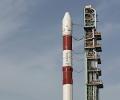
ISRO said, initially the launch was slated for 9.49 am, but now there is a 3-minute delay owing to the probability of space debris in the path of rocket.

Rediff.com presents some of the amazing pictures captured by Envisat over the years, as it completes a decade in space.

"It is going to be the most complex mission ever undertaken by ISRO. It is going to take place between July 9 and 16, this year," Sivan said, addressing scientists from the Mission Control Centre.

A satellite placed in the halo orbit around the first Lagrangian point (L1) of the Sun-Earth system has the major advantage of continuously viewing the Sun without any occultation/eclipses, the IIA said.

The space agency had earlier announced that the launch is tentatively scheduled at 09:28 hrs IST on November 25, subject to weather conditions.

ISRO's maiden solar mission, Aditya L1, has captured its first high energy X-ray glimpse of solar flares. During its first observation period from approximately October 29, the High Energy L1 Orbiting X-ray Spectrometer (HEL1OS) on board Aditya-L1 spacecraft has recorded the impulsive phase of solar flares, the space agency said in a statement on Tuesday.
A global composite image, constructed using cloud-free night images from a new NASA and National Oceanic and Atmospheric Administration satellite, shows the glow of natural and human-built phenomena across the planet in greater detail than ever before.

The Lagrange point 1 (L1) of the Sun-Earth system is about 1.5 million km from the Earth. It is about one per cent of the total distance between the Earth and the Sun.
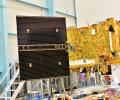
Aditya-L1 spacecraft is designed for providing remote observations of the solar corona and in situ observations of the solar wind at L1 (Sun-Earth Lagrangian point), which is about 1.5 million kilometres from the earth.

Aditya-L1, the first space-based Indian observatory to study the Sun, is getting ready for its launch soon, ISRO said on Monday.

The launch of the crewed space mission, Gaganyaan, is being planned before the next Independence Day and this will be proceeded by two uncrewed missions, Lok Sabha was informed on Wednesday.

The total solar eclipse of 2024 was a historic celestial event because it won't be visible across the contiguous US again until August 2044 and an annular eclipse -- which happens when the Moon can't completely blocks the Sun-- won't appear across this part of the world again until 2046.

For the second time in a year, a NASA camera aboard the Deep Space Climate Observatory satellite captured a 'lunar photobomb' -- a stunning view the Moon as it moved in front of the sunlit side of Earth, crossing over the Indian and Pacific oceans.

If all goes on well, the NISAR satellite will be launched in 2021 from India using the Geo-synchronous Satellite Launch Vehicle (GSLV).

Out of its 47 operational satellites, India currently has six to eight satellites which are used entirely for military purposes.

The Indian Space Research Organisation has resolved to alight its lander on the lunar surface with Chandrayaan-3 in addition to a maiden solar expedition in 2020.

CARTOSAT-3 is a third generation agile advanced satellite having high resolution imaging capability.

The Mars Orbiter Mission (MOM) is among the most-tracked satellites in the world, according to N2YO, which provides a web-based real-time satellite mapping website.

Between April 25 and May 2, India received 38,885 fire alerts.
The United States on Friday slammed as "highly provocative" North Korea's plan to launch a long-range rocket next month to put a satellite into orbit, in violation of its international obligations.

UN Secretary General Ban Ki-moon denounced the launch and asked North Korea to halt its 'provocative actions' and return to compliance with its international obligations.

The year ended with the launch of the PSLV's 50th mission.

The Chandrayaan-2 will conduct the next level of scientific studies on the Moon, writes T E Narasimhan.
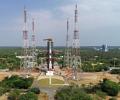
Days after landing on the Moon, India will aim for the Sun on Saturday with its maiden solar expedition, as ISRO's trusted PSLV will carry the Aditya L1 mission on a 125-day voyage to the Sun.

Experts said India has possessed the anti-missile technology for several years but needed the political go-ahead to actually test it in live conditions.

The ISRO plans to send three Indians to space by 2022, an announcement made by Prime Minister Narendra Modi during his last Independence Day speech.
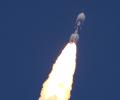
India's first solar mission, if successful, will showcase ISRO's ability to explore the cosmos, explains Kumar Abishek.

The space agency launched 104 satellites, breaking the previous record of 37 by Russia.

Shifting the focus to its next space odyssey after successfully placing a lander on the moon's uncharted South Pole region, the Indian Space Research Organisation (ISRO) chief S Somanath on Saturday said that the country's maiden solar mission Aditya-L1 is ready and will be launched in the first week of September.

ISRO made efforts to re-establish communication with rover Pragyan and lander Vikram after they were put into sleep mode in September following the onset of night on the moon.

The Vikram lander was 100 kilometers away from LRO, near Manzinus crater in the Moon's south pole region, when LRO transmitted laser pulses toward it on December 12 last year.

ISRO will now conduct further testing of VELC and its eventual integration with the Aditya-L1 spacecraft, it said in a release.

Singh also said a final decision on the launch of India's sun mission 'Aditya-L1', scheduled for September 2 at present, will rest on the prevailing cosmic aspects.

According to the space agency, Chandra's Surface Thermophysical Experiment measured the temperature profile of the lunar topsoil around the south pole, to understand the thermal behaviour of the Moon's surface.
 © 2026 Rediff.com - Advertise with us - Disclaimer - Privacy Policy - Sitemap - Feedback - About us - Terms of use - Grievances